
Conversion Tracking — show your ad platforms what actually sold.
Send every order to Google Analytics 4, Google Ads, Meta, Microsoft Advertising, TikTok, Matomo, Plausible, Umami or Fathom — with its value, and its products where the tool takes them, once, and only after the shopper agrees. Type the tool’s ID on the store screen: no template edits, no tag manager container, no purchase code to write.
Ads learn from purchases. Give them one with a value.
Google Ads, Meta and TikTok bid towards whatever their purchase signal says is working. Without one, they optimise for clicks and you guess at your return on ad spend. With one, every campaign is measured — and steered — by the orders it brings in.
Solidshop builds each order once on the confirmation page, with amounts that match the
order screen to the cent and products named by SKU. The plugin hands that order to each
tool in the shape the tool expects: a GA4 purchase, a Google Ads conversion, a
Meta or TikTok Purchase, a Microsoft Advertising purchase, a Matomo ecommerce
order, or a goal in Plausible, Umami or Fathom.
Setup and every option are covered in the Conversion Tracking documentation.
Built on what every Solidshop store already has.
Solidshop 1.8.0 ships the neutral layer free. If you already run Google Tag Manager and like building tags, it may be all you need. The plugin is for the store that would rather type an ID.
Free in core: the order on the data layer
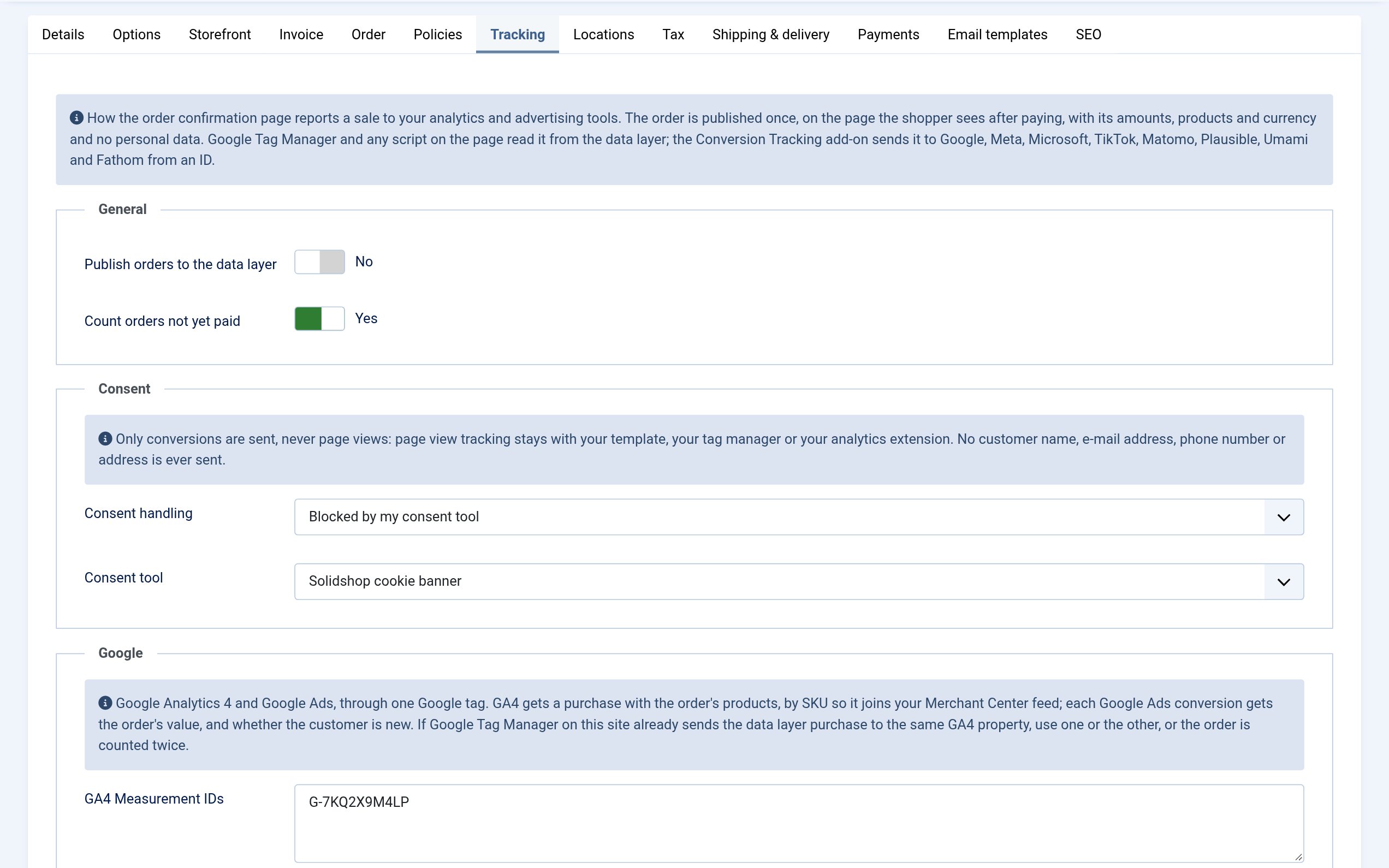
Switch it on in the store’s Tracking tab and every confirmation page publishes the
order as a GA4 ecommerce purchase on dataLayer and as a
solidshop:purchase browser event. Point a Tag Manager tag at it, or a script of
your own.
Free in core: a cookie banner of your own
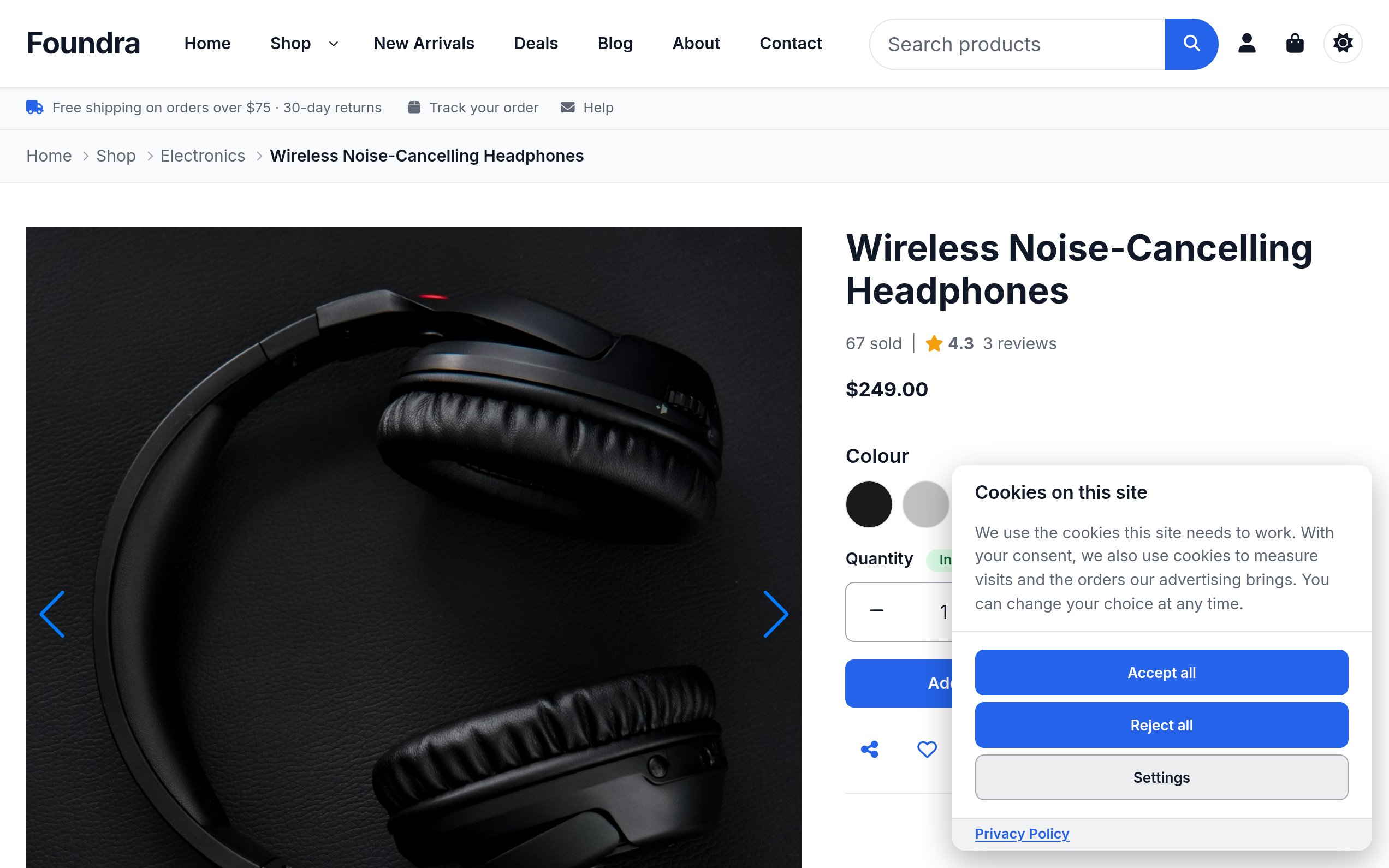
Asks each visitor once, holds scripts back until they accept, and passes the choice to Google tags through Consent Mode v2. No third-party account — it runs on your site, in your template’s colours and the shopper’s language.
The plugin: no container to build
Tag Manager means a container, triggers, variables and a tag per platform, kept in step with your store by hand. The plugin replaces all of it with one field per tool on the store screen, and loads each tool’s script for you.
The plugin: each platform’s own event
Ad platforms don’t read a GA4 data layer. The plugin sends Meta, TikTok and Microsoft their own purchase events, with the total paid and the products by SKU, and gives Google Ads its conversion and remarketing calls — each held back until the shopper consents.
Nine tools, one Tracking tab, consent built in.
Nine tools, set up from an ID
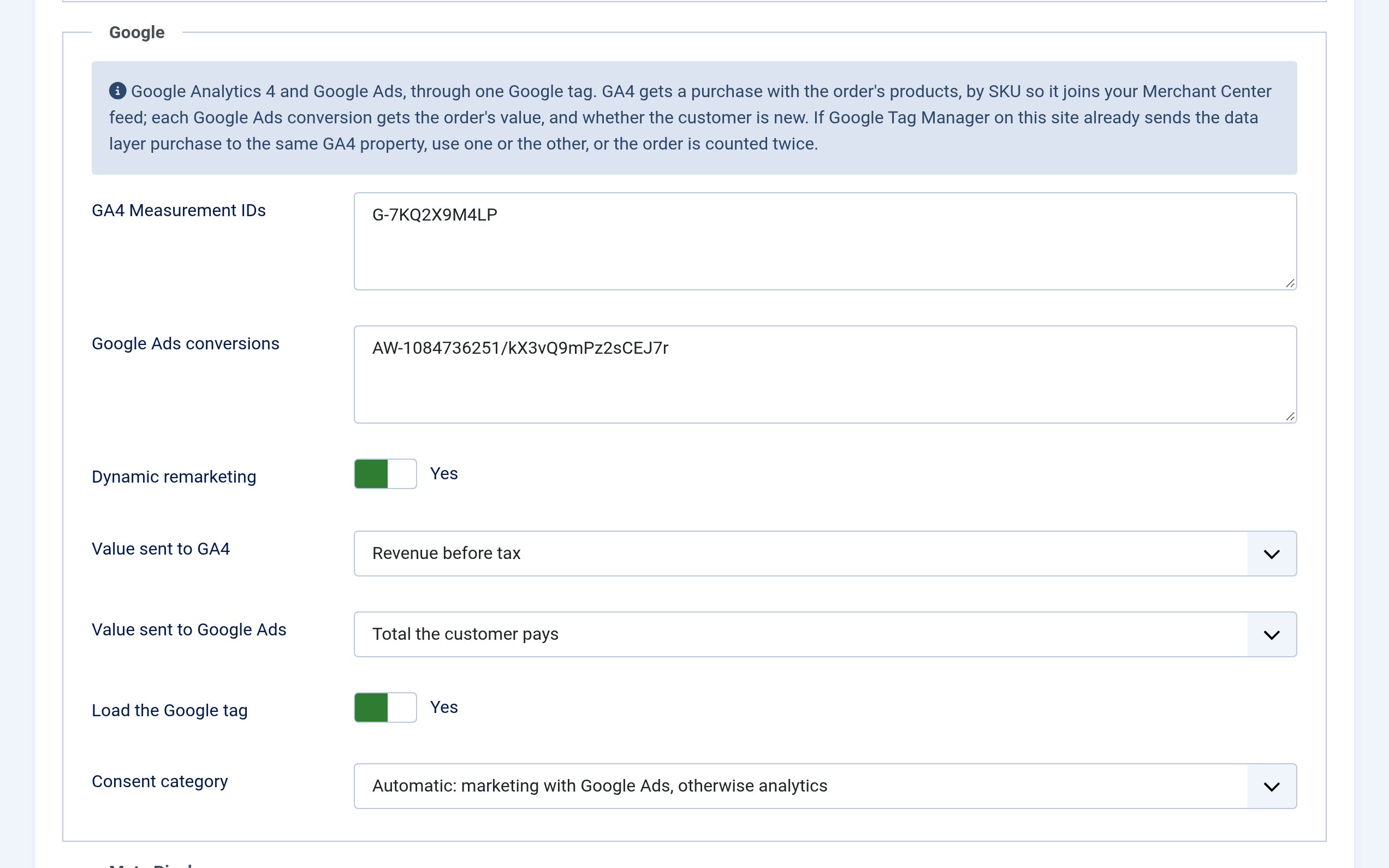
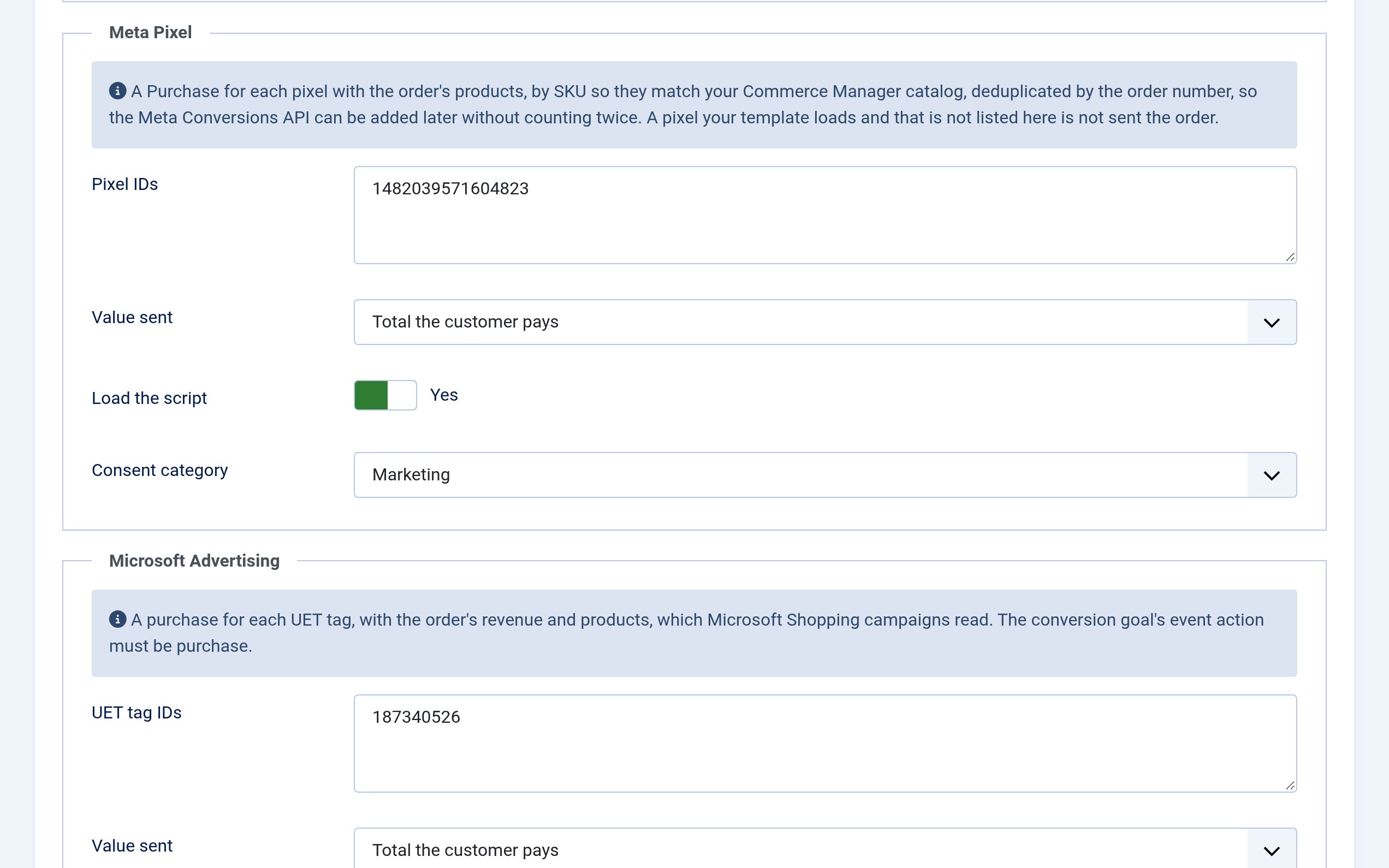
Google Analytics 4, Google Ads, Meta Pixel, Microsoft Advertising, TikTok, Matomo, Plausible, Umami and Fathom. Paste a Measurement ID, a pixel ID or a conversion label and save — several per ad or Google tool, one per line. An ID in the wrong format is refused on save, with the entry named.
Asks first
Every script waits for Solidshop’s cookie banner: ad platforms for Marketing, analytics for Analytics. The banner asks while the shopper browses, not on the confirmation page. Already run Cookiebot, CookieConsent, n3t or Klaro? The scripts are written in that tool’s markup instead.
The right amount for each tool
Analytics gets revenue before tax and shipping — the figure your sales report shows. Ad platforms get the total the customer paid — the figure return on ad spend is measured against. Each tool has its own switch if you count differently.
Each order counted once
A reload, the back button or a late consent never reports an order twice. Meta and TikTok get the order number as the event ID, so adding their server-side APIs later won’t double your conversions.
Products your catalog feeds know
Products go out by SKU, the id Google Merchant Center and Meta’s catalog import from your feed, so Shopping and catalog ads see which products sold. Optional dynamic remarketing sends Google Ads the products bought, under the retail vertical.
New or returning customers
GA4 learns whether the buyer is new or returning, and each Google Ads conversion carries
new_customer — what the new customer acquisition goal needs to
bid higher for first orders.
Only orders that count
Voided, cancelled and refunded orders are never reported. Bank transfer and cash on delivery orders count from the moment they are placed, or not at all — one switch on the store decides.
No personal data
Tools get the order number, amounts, currency, coupon and products — never a name, an e-mail address or a postal address. Matomo tracks without its cookies by default. No tool is sent a page view.
Works with what you already load
Your template or Tag Manager already loads the Meta Pixel? Switch the card’s Load the script off and the plugin sends the order to the copy your site has, so nothing loads or counts twice.
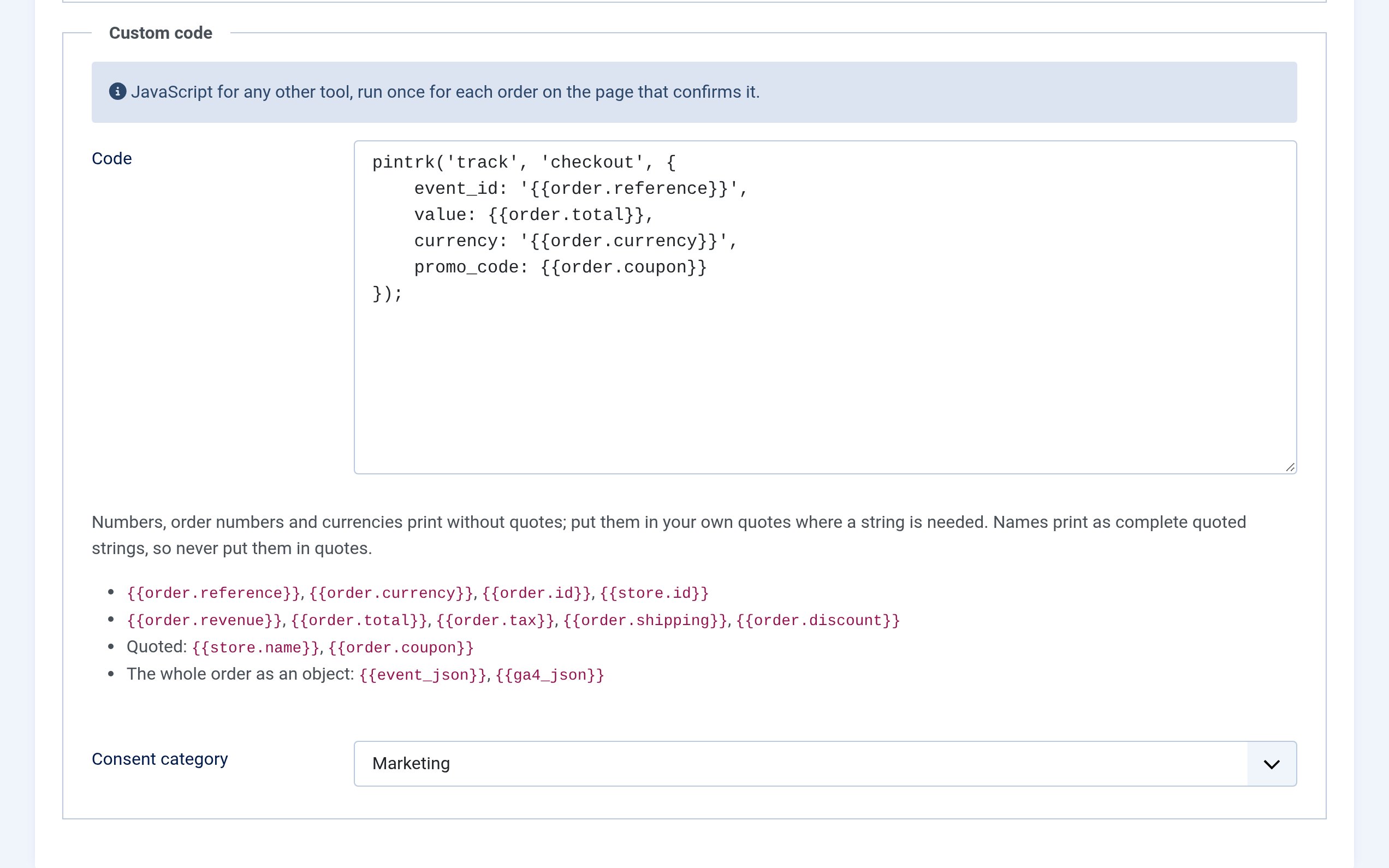
Custom code with order tokens
Pinterest, an affiliate network, a CRM: paste their snippet and drop in
{{order.total}}, {{order.reference}}, {{order.coupon}}
and more. It runs once per order and waits for consent like the rest. Only users who may
change Solidshop’s Options can edit it.
On the store screen
Settings live on the store’s Tracking tab, next to its payments and shipping — not in the Plugins screen, which only Super Users can open. Each store keeps its own IDs, and the dashboard’s setup checklist links straight to it.
Ready for a strict Content Security Policy
Every script the plugin adds carries the page’s nonce, so a policy that allows only nonced scripts — as Joomla’s HTTP Headers plugin can set — runs the tools and your custom code without exceptions.
From the store screen to the shopper’s yes
What's inside.
| Extension type | Solidshop plugin (plg_solidshop_conversions) |
|---|---|
| Compatibility | Joomla 6.x+ · PHP 8.4+ · Solidshop 1.8.0+ |
| Licence | GNU General Public License v3 |
| Tools | Google Analytics 4, Google Ads (conversions and dynamic remarketing), Meta Pixel, Microsoft Advertising (UET), TikTok Pixel, Matomo, Plausible, Umami, Fathom — plus custom code for anything else |
| What each tool gets | GA4 purchase · Google Ads conversion · Meta and TikTok Purchase · Microsoft purchase · Matomo ecommerce order · a named goal in Plausible, Umami and Fathom |
| Order data | Order number, revenue, total, tax, shipping, discount, currency, coupon; each product’s SKU, name, variant, category, brand, price and quantity. No personal data |
| Consent | Solidshop cookie banner (default) with Google Consent Mode v2 · CookieConsent v3, Cookiebot, n3t Cookie Consent, Klaro or a custom data- attribute · none, for consent managed in Tag Manager |
| Custom code tokens | {{order.id}}, {{order.reference}}, {{order.revenue}}, {{order.total}}, {{order.tax}}, {{order.shipping}}, {{order.discount}}, {{order.currency}}, {{order.coupon}}, {{store.id}}, {{store.name}}, {{event_json}}, {{ga4_json}} |
| Settings | Per store, on the store’s Tracking tab · custom code limited to users who may change Solidshop’s Options |
| Languages | 23 admin locales bundled |
| Update channel | 12 months of updates included; renew at 30% off thereafter |
Latest release
1.0.0
StableFirst public release of the Conversion Tracking plugin for Solidshop (plg_solidshop_conversions). Needs Solidshop 1.8.0, which reports each order on its confirmation page and ships the cookie banner the plugin waits for. Establishes the baseline that all future changelog entries are deltas against.
Added
- Each order sent to the store's analytics and advertising tools from their IDs, once, from the order confirmation page: Google Analytics 4 (a
purchasewith its items, tax, shipping, coupon and new or returning customer), Google Ads (a conversion per conversion label, with the order's value andnew_customer, and optional dynamic remarketing under the retail vertical), Meta Pixel and TikTok (aPurchaseper pixel, sent to that pixel only and deduplicated by the order number), Microsoft Advertising (apurchaseper UET tag, each tag on its own queue), Matomo (an ecommerce order with its lines, tax, shipping and discount), and Plausible, Umami and Fathom (a named event,Orderby default, with its value). Products are sent by SKU, else the product id, so purchases join Merchant Center and the Meta catalog. No page view is ever sent and no personal data. - Every setting belongs to the store, on cards that join the store's Tracking tab: on a site with several stores, each reports to its own accounts. IDs are checked when the store is saved and again before a page uses them.
- A Value sent choice per tool: the revenue before tax (the sales report's figure, the default for the analytics tools) or the total the customer pays (the default for the ad platforms and Matomo).
- Consent: out of the box every script waits for Solidshop's own cookie banner and runs once the shopper accepts its category (Marketing for the ad platforms, Analytics for the analytics tools, Google by whether it sends to Google Ads); the banner asks while the shopper browses the shop, and the store screen warns when the banner is off. The scripts can be written instead for CookieConsent v3 (YOOtheme Pro), Cookiebot, n3t Cookie Consent, Klaro or a custom attribute, or run without consent.
- Load the script per tool, to send the order to a copy the site already loads (Google Tag Manager, a template setting) instead of loading another.
- Custom code for any other tool, run once per order, with typed tokens for the order's number, amounts, currency, coupon and store, and the whole order as JSON. Only users who may change Solidshop's Options see or change it; anyone else's save keeps it.
- A Measure your sales step in the dashboard's store setup checklist.
- Enabled on install; silent until a store sets a tool up.
Let your ad budget see what sold.
Nine tools from one Tracking tab, each order counted once, nothing sent before the shopper says yes. One purchase, GPL-3 source.