
A product on more than one shelf, a shop page for a tag, a Look screen with a live preview, a cookie banner of your own, each order reported once, and WooCommerce exports that import as they are — with Conversion Tracking and Square new alongside, and five more add-on updates.
Core 1.8.0 is out, and it is about how your store looks and what it reports. A Look screen changes a Foundra store’s preset, colours, fonts, header and footer beside a preview of your home page, without a trip to Template Styles. Solidshop gets a cookie banner of its own, and the order confirmation page can report each order once to Google Tag Manager, GA4 and any tag on the page.
A product can now be listed in more than one category, a tag can have a shop page, and a WooCommerce export imports as it is. A payment that fails at the provider no longer ends on the order confirmation. And three security fixes keep products a visitor cannot open out of listings and search suggestions, and keep each store’s tax settings its own: reason enough to update.
One product on more than one shelf
Until now a product sat in one category: a webcam went under Electronics or under Gift Ideas, not both. In 1.8.0 a product keeps one main category and can be listed in any number of additional categories, without a second copy of the product. The product form’s Category is now Main category, with the same meaning, and a new Additional categories field sits under it.
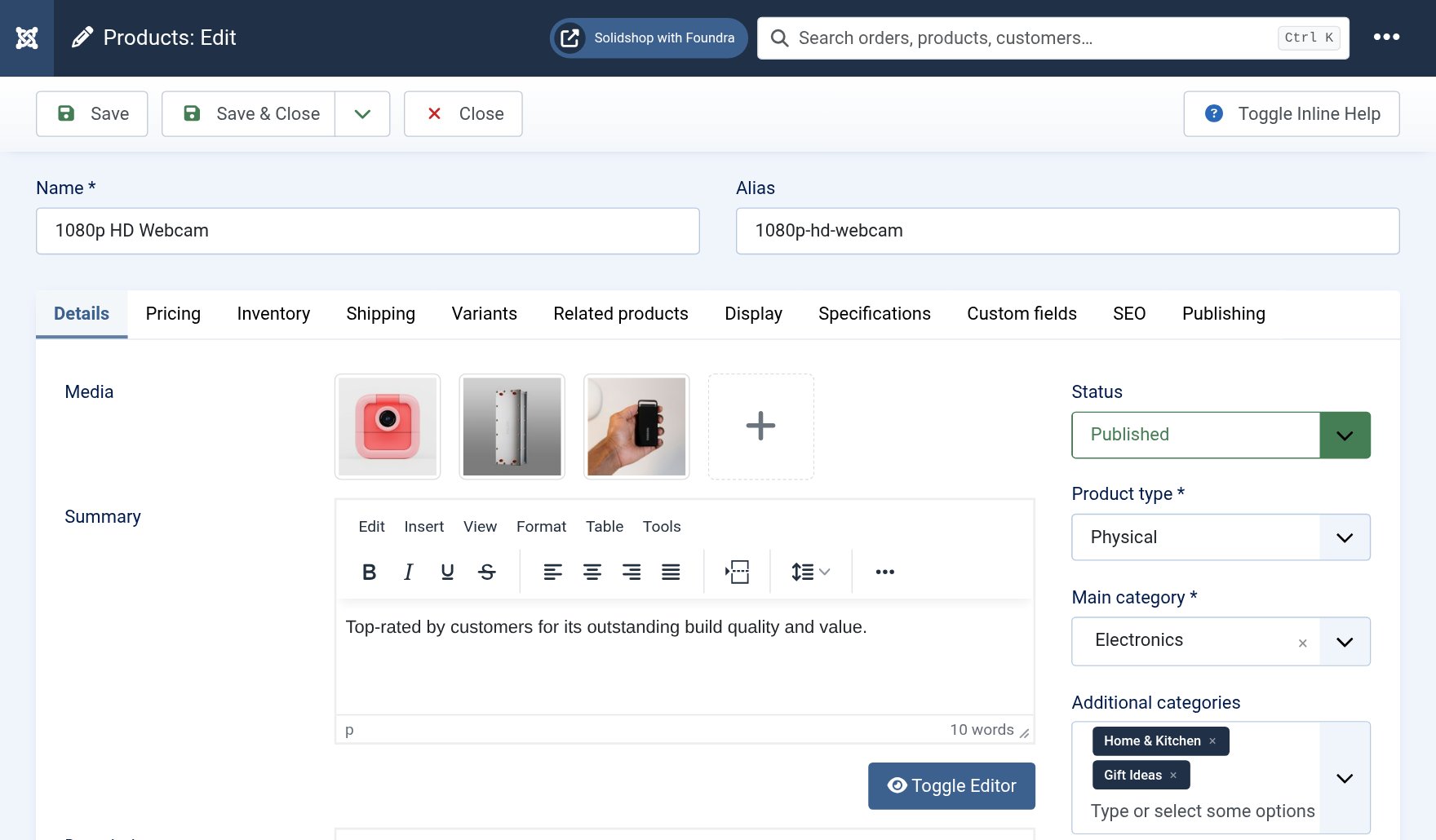
The product shows on each of those category pages and wherever
Solidshop lists by category: the Filters module’s category
filter and its counts, the Categories module’s tiles, the
Products and Reviews modules, Smart Search’s Category
filter, and the XML sitemap and /llms.txt. A category
that holds only additional listings gets its page and its tile like
any other.
The main category still decides the rest: the breadcrumb, who may see the product, its custom fields, its admin permissions and its place in the admin ordering. Custom fields stay with the main category because they feed the product’s filters and its Specifications tab: a product listed in Gifts does not pick up the Gifts fields. An unpublished or restricted additional category hides only its own listing. Product URLs carry no category, so nothing about a product’s address changes. One exception: opened from the menu item of an additional category, the product’s breadcrumb follows that menu item, without the main category added on top.
Many products at once
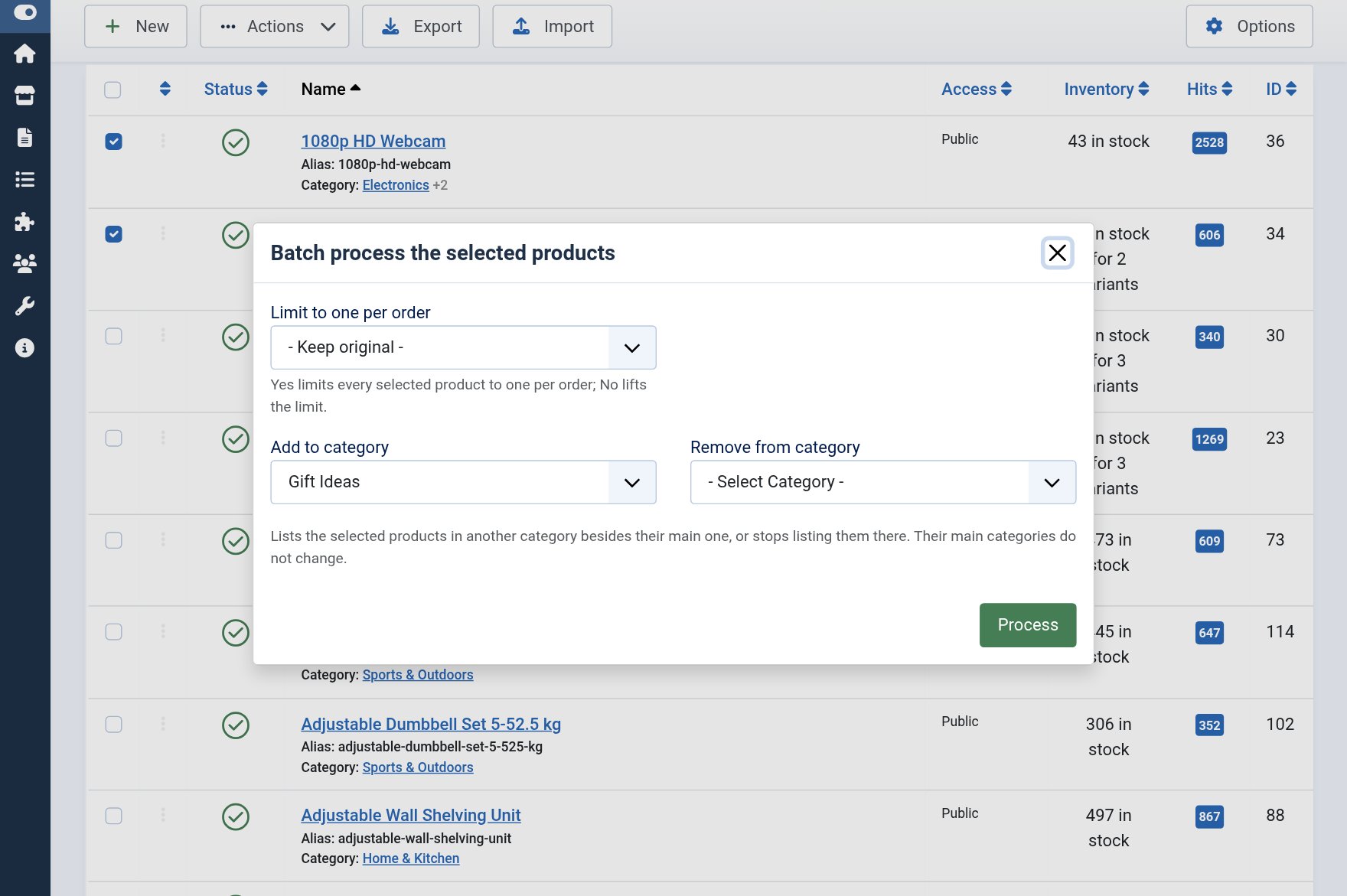
Tick products in the Products list and open Actions › Batch: Add to category lists them in a category besides their main one, and Remove from category takes them out again. The list shows a product’s main category followed by +2 when it has two additional ones, with their names on hover and focus, and its Category filter finds a product listed there either way.
Product CSVs gain an Additional Categories column,
paths separated by |; a blank cell leaves a
product’s additional categories alone. A discount scoped to a
category reaches products listed in it either way, as do the
Discount & Coupons rules from 1.1.0, and
the VirtueMart migrator now brings every
category a product was in. See
additional
categories in the products guide.
A shop page for a tag
Some lists come and go: a Black Friday sale, the season’s gifts, new arrivals. In 1.8.0 such a list can be a tag. The Products menu item (Product list among Solidshop’s menu item types) has a new Tags option. Pick one or more tags, and the page lists every product that carries any of them, with product cards, prices, sorting and the Filters module, under the menu item’s own title and address. Categories and Products on Sale Only narrow it further.
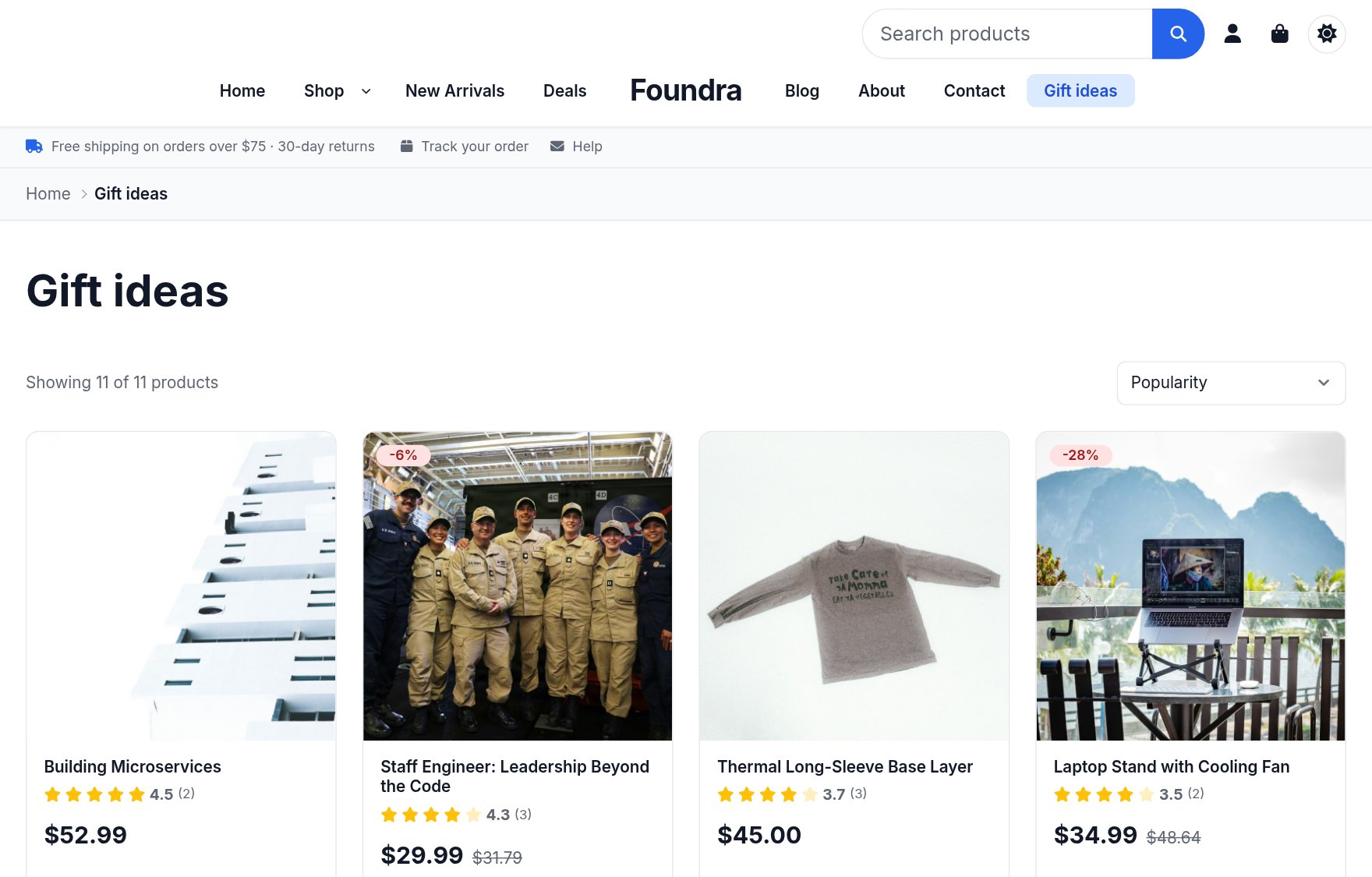
Search engines index a tag listing like any menu page, and on it the Filters module’s Tags section leaves out the listing’s own tags. The products module has the same Tags option, for a “Black Friday” strip on the home page. A tag lists products only while it is published and in a view level the visitor holds, as on Joomla’s own tag pages, so unpublishing the tag when the sale ends empties the page. See tag listings in the storefront guide.
Change the look in Solidshop
Solidshop › Configuration › Look puts a Foundra store’s design in Solidshop’s own back office: preset, colours, fonts, logo, header, footer, page background, corners and custom CSS, beside a preview of your home page drawn with your changes before they are saved. Each change redraws the preview within a second, at desktop or phone width. Nothing changes on the store until you press Save, and saving clears Joomla’s page cache and Solidshop’s cache, so the change shows at once.
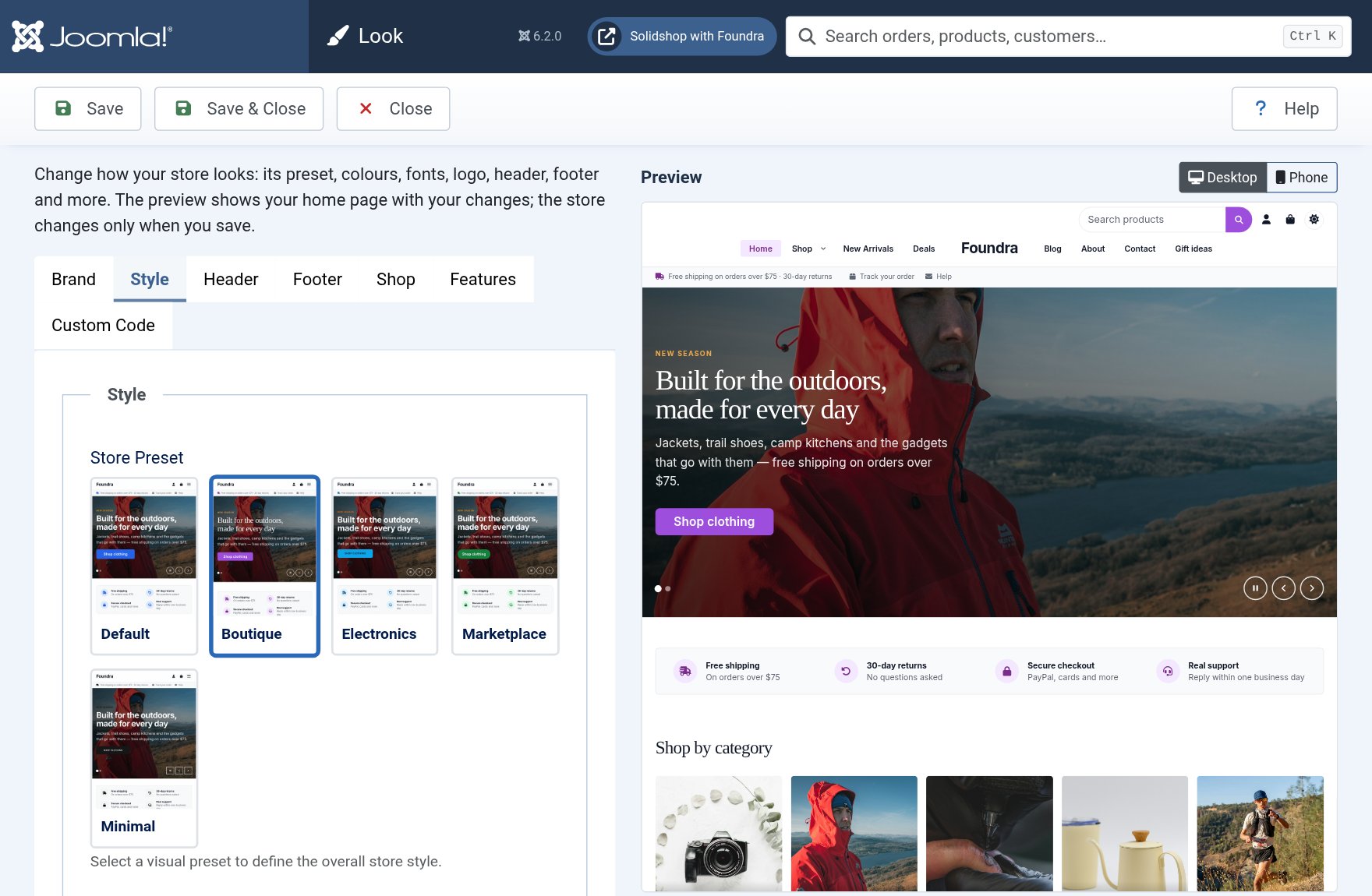
The screen needs the right to change Solidshop’s options, the same as the Options button, and never access to Template Styles, so a member of staff with an Administrator account can change the design without being a Super User. It draws Foundra’s own options form, so a setting Foundra adds later reaches the screen with no Solidshop update, and a change made here shows in Template Styles too. The preview is your home page drawn from values the back office signs with your site’s secret; it is never cached or indexed.
What Foundra 1.2.0 adds
The Look screen arrives with Foundra 1.2.0, which turns the look of a store into a set of choices, so that two Foundra stores no longer read as the same template:
- Header Layout: the logo on the left (as it was), the logo in the middle with the menu below, a large logo above the menu, or the menu split either side of the logo. Header Colour plain, primary or dark, a header lying transparent over the hero, and Pin the Header.
- Footer Layout: columns, or Centered, opening with the logo. Footer Colour dark, plain or primary.
- Page Background soft grey, warm or tinted with the primary colour, and Corners sharp, softly rounded or round.
- Heading Font and Body Font, from the visitor’s device or from four faces Foundra now ships (Inter, Manrope, EB Garamond and Noto Serif Display), served from your own site and loaded only when chosen.
- Product Picture Ratio: square, portrait or landscape pictures on product cards.
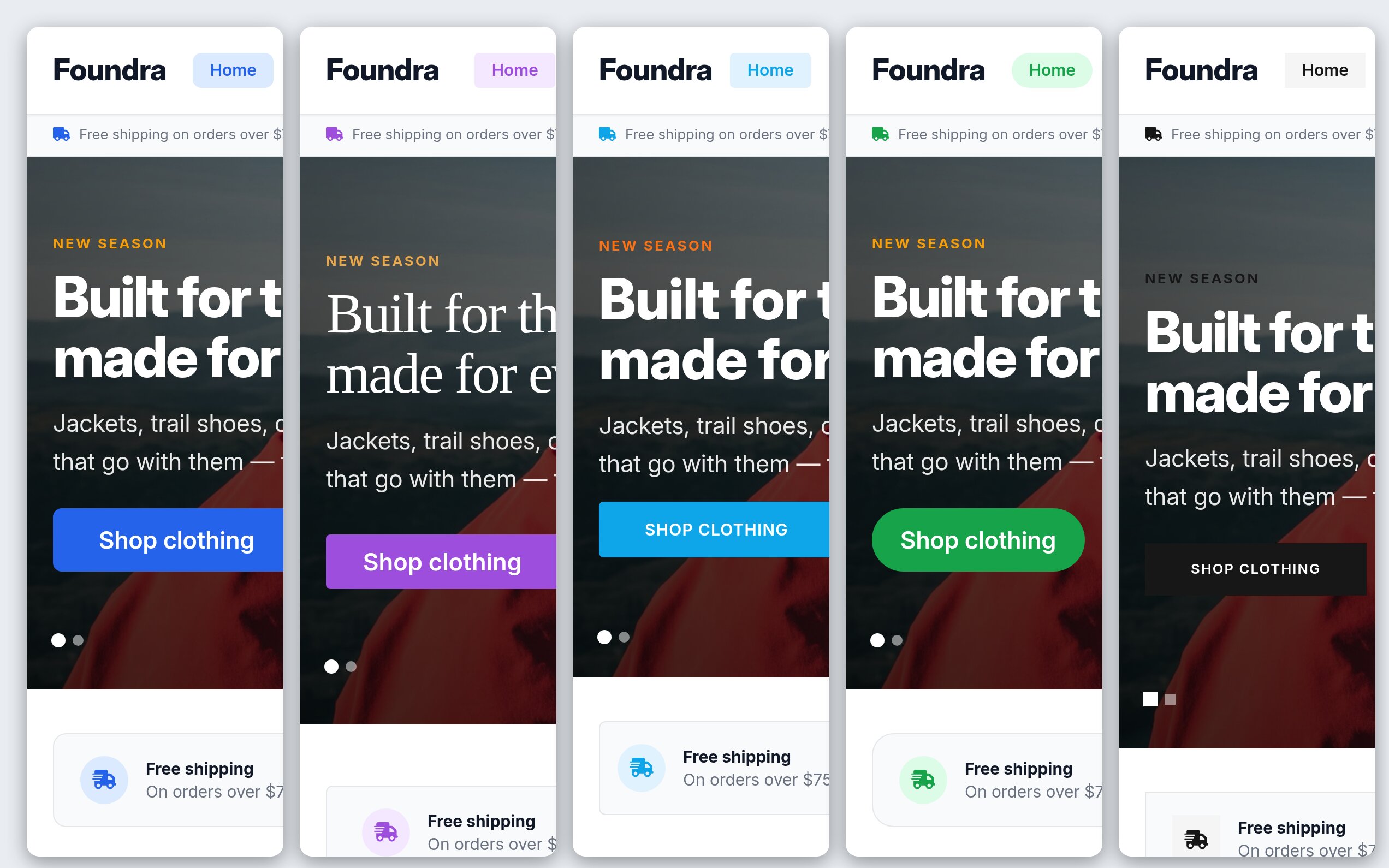
Each new choice starts at Preset default, so no store changes on update. With Foundra 1.1.0 the Look screen shows the store as saved, and on a site whose default template is not Foundra it says so. See changing the look of your store.
A cookie banner of your own
Turn on the Cookie consent tab of Configuration › Settings and Solidshop shows a cookie banner on every page of the site: a box, a bar or a centred dialog, in the site’s language and your template’s light and dark colours. Necessary cookies are always on; Analytics, Marketing and Preferences are offered as you choose, and Accept all, Reject all and Settings carry equal weight. It asks only when the page has something to ask about (a script marked to wait for consent, a Google tag, a tracker a plugin adds), so a store with no tags shows no banner.
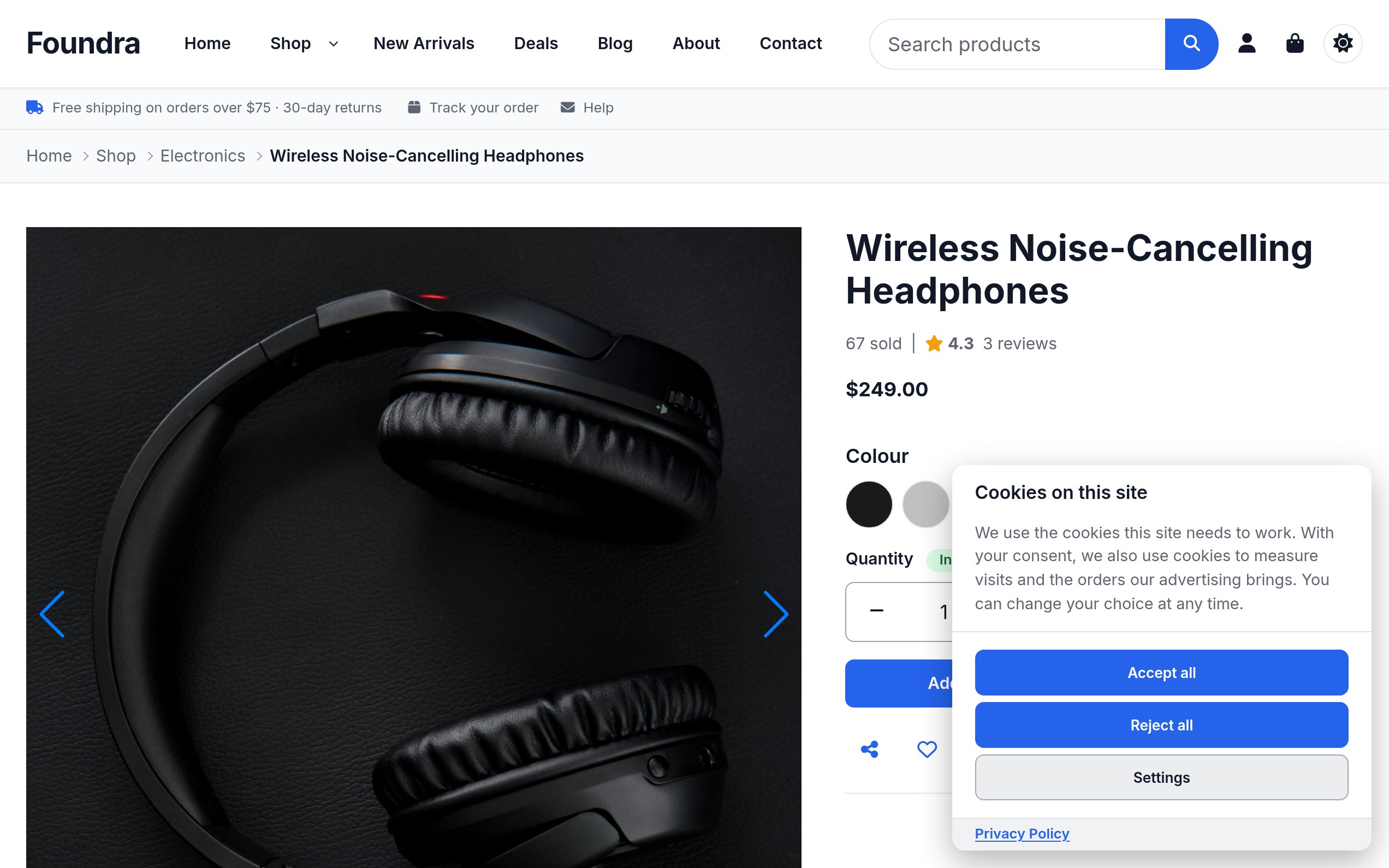
A script of your own waits for consent when you write it like this:
<script type="text/plain" data-category="analytics" src="https://example.com/analytics.js"></script>
Once the visitor accepts its category, the banner runs it. Google tags
get Consent Mode v2 signals, everything denied until a choice and
updated on each one, so a gtag or a Tag Manager container
reads the state on its own.
You set how many months a choice is kept, raise a revision number to
ask everyone again, and can add a sentence of your own. The banner
links the privacy policy from the store’s Policies tab,
and a #cookie-settings link reopens it. It keeps the
choice in the visitor’s browser and records nothing on the
server, and it is not an IAB TCF platform: no vendor list, no
geo-targeting. It is off after the update; sites built from a Solidshop
quickstart have it on. See
cookie consent.
Every order counted once
The order confirmation page now reports the order the way Google Tag
Manager, GA4 and tracking scripts expect: a GA4 ecommerce
purchase pushed to window.dataLayer and a
solidshop:purchase event in the browser, with the
order’s amounts, currency, coupon, products and payment state,
and no personal data.
It fires once per order, never on a refresh, and never for an order that was voided, cancelled or refunded. A payment that fails at the provider now voids its order before the confirmation page (below), so it is not counted either.
Two switches sit on the store’s new Tracking tab. Publish orders to the data layer is off by default: nothing is sent anywhere until a tag on the page reads it. Count orders not yet paid is on by default, so a store that sells on bank transfer or cash on delivery still counts its sales, flagged as not paid.
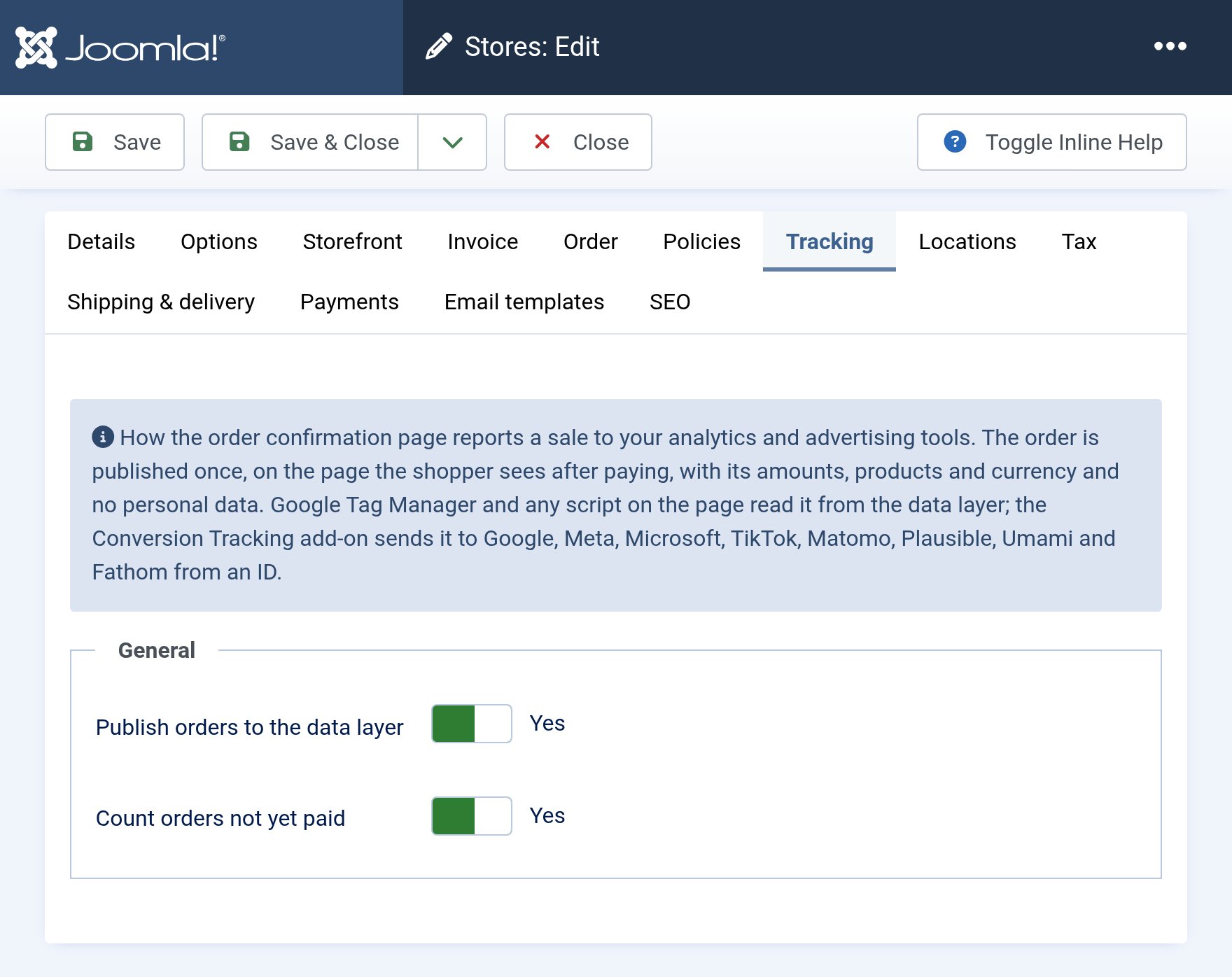
The push follows GA4’s ecommerce shape, so a GA4 tag in Tag Manager needs no mapping, and the amounts come from the order itself, matching the order screen to the cent. Each store reports to its own tools. The conversion tracking guide has the Tag Manager steps and the whole event. Rather not build tags? The new Conversion Tracking add-on sends each order to GA4, Google Ads, Meta, Microsoft Advertising, TikTok, Matomo, Plausible, Umami and Fathom from their IDs.
Import a WooCommerce shop as it is
A WooCommerce product export did not come through Solidshop’s import intact. Sale price took the Price column, so a product not on sale came in without a price; In stock?, a yes/no flag, took Quantity, so a product in stock came in with one unit; and an attribute stopped its row. In 1.8.0 you export from Products › Export in WordPress with all columns, and upload the file as it is.
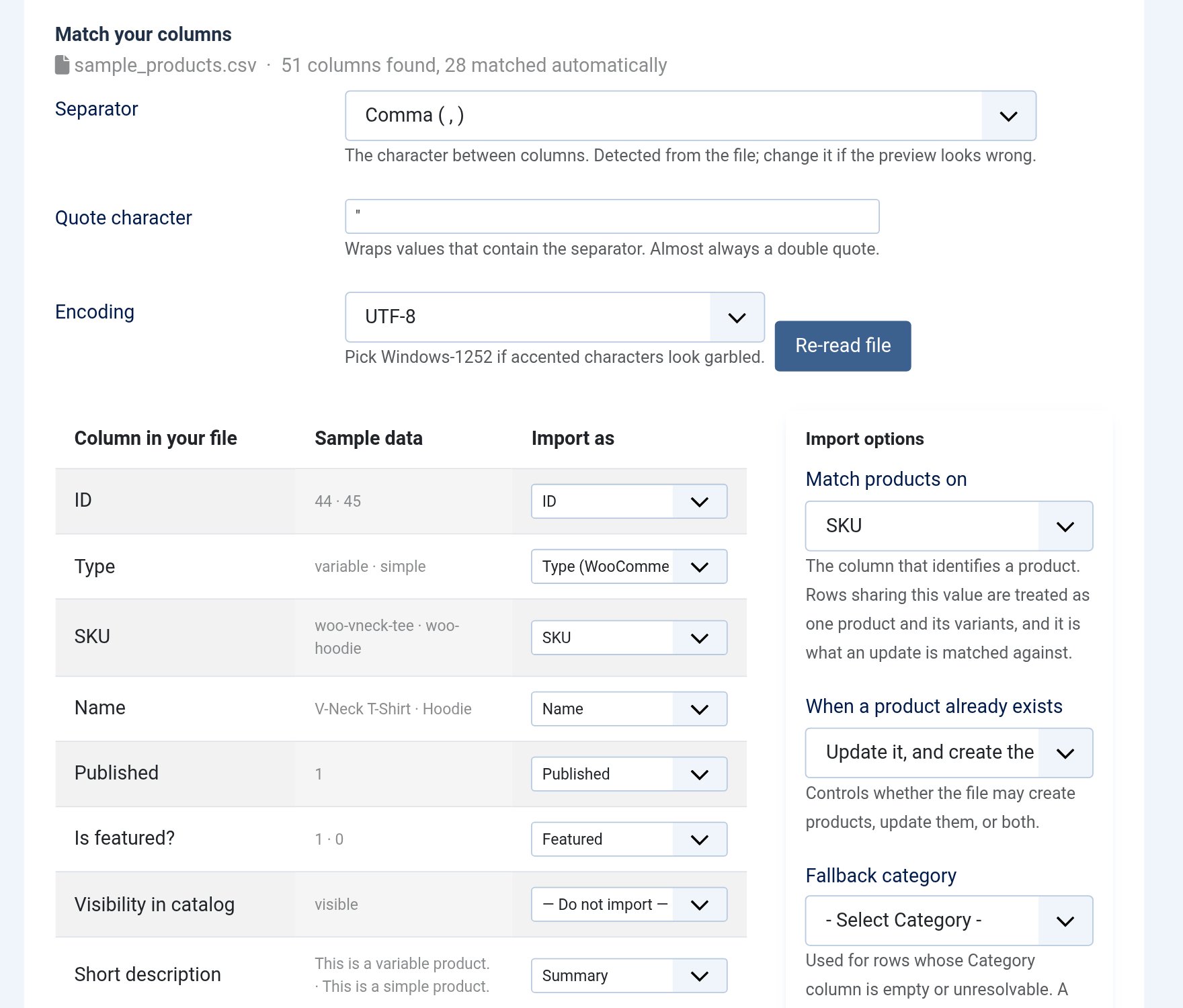
- Matching. The file has no alias, so the mapping screen proposes matching products on SKU. A product without a SKU is reported instead of merging into the product above it.
- Prices. A product on sale gets its sale price, with the regular price as its compare-at price. A sale outside its dates imports the regular price.
- Stock WooCommerce counted is tracked; stock it did not count is not, so the product stays orderable.
- Categories. The deepest category in WooCommerce’s Categories cell becomes the main one, and the others additional categories.
- Attributes fill the custom field of the same name, so a Color field can still be filtered on, or become specification rows.
- Variations become variants with their own price, sale price, stock, weight and SKU. Combinations WooCommerce does not sell come in sold out, and a variation left at “any” value becomes a variant for each value. Past three options or 150 combinations, a product comes in without its variations, unpublished, and so does a grouped product, as Solidshop has none.
- Weight in kilograms, grams, pounds or ounces is converted to the unit your store keeps.
- Virtual and downloadable products keep their type, with the download limit and expiry when the Downloadable add-on is installed.
WooCommerce writes its headings in the shop’s language (Catégories, Poids (livres)), and the import recognises them in 36 languages, regional variants included.
Two fixes reach every product CSV. A file that listed only some of a product’s variants created the rest at price 0 with stock not tracked, so they could be bought for nothing; they now come in out of stock at the product’s lowest variant price. And a variant row with a blank Variant Price takes the product’s Price instead of 0. See importing from WooCommerce.
Security fixes
Three fixes in the core and one in the Reviews add-on. We recommend updating promptly.
- Listings showed products the visitor could not open. A product with an access level such as Registered or Special, or in a category with one, was listed to every visitor: on the storefront listing and its filter counts, in the Products module, in the Categories and Brands modules’ counts and tile pictures, and in search suggestions. Its own page then answered “403 Forbidden”. Each now checks the product’s access level and its category’s. Search suggestions also leave out products that are scheduled, expired or in an unpublished category.
-
The XML sitemap and
/llms.txtlisted products in restricted categories, sending search engines and AI agents to pages that answered “403 Forbidden”. - A store’s tax settings stay its own. Saving a tax zone, class or rate from a store’s Tax tab did not check that the row belonged to that store, so an admin of one store could rename another store’s tax rows and move them into their own. A save now refuses them with “Tax record not found.”, and a product saved through the API or an import can no longer take another store’s tax class. Only a site with more than one store, and an admin allowed to edit some of them but not all, was exposed.
- Reviews 1.1.2: the Reviews module showed reviews of products in restricted categories to guests, with a link to a page that answered “403 Forbidden”.
Also in this release
- A payment that fails off the page returns to the checkout. A shopper who left to pay at the provider (Klarna, Affirm, iDEAL or Amazon Pay through Stripe, or another gateway’s hosted page) came back to the confirmation page whatever had happened there, and the confirmation e-mail went out. The shop now asks the gateway first: a payment that failed or was cancelled voids the order and brings the shopper back to the checkout with their cart, to pay again or another way. Stripe 1.0.1 answers; a gateway that does not keeps the old behaviour.
-
Every product has a URL of its own. An alias was
only checked against products in the same category, so a
Classic Tee under Men and one under Women both became
classic-tee, and both links opened the older one. An alias is now unique within its store (and, with multilingual content on, within a language); a taken alias gets the next free number, and the product form says so on save. CSV import, the migrator and batch copy follow the same rule. The update gives every product that had no working URL an alias of its own and lists them. - A category that products still belong to can no longer be deleted. Its products used to point at a category that no longer existed, and the storefront stopped showing them. The delete is now refused with the number of products to move first, products in the trash included.
- A tax zone needs a territory. A zone saved with none charged no tax anywhere, with nothing to show for it. Saving now asks for at least one territory and a country on every row; a zone saved empty before is marked No territories on the Tax tab.
- Orders on a store never saved through its form start Pending, not Authorized, so cash on delivery and bank transfer orders on a new or quickstart store no longer read as authorised payments.
- Every listing opens on its first page. After page 3 of the shop, a category or the Deals page opened on page 3 too, often showing a single product.
- The Filters module offers only categories the visitor may open, and a tag that is unpublished or restricted lists nothing.
- Joomla’s Tagged Items pages and Similar Tags module link products to their own page, and no longer leave them out under a language filter.
- Search Customer on the Create Order screen finds customers again, the sample products a new install comes with can be saved, and uninstalling Solidshop removes only the menu items it made.
Released alongside 1.8.0
Seven extensions ship with this release, two of them new.
Conversion Tracking 1.0.0 (new)
Conversion Tracking sends each order to your analytics and advertising tools from their IDs, once, from the order confirmation page: Google Analytics 4, Google Ads (a conversion per label, with optional dynamic remarketing), Meta Pixel and TikTok (deduplicated by the order number), Microsoft Advertising, Matomo, and Plausible, Umami and Fathom. Products go by SKU, so purchases join Merchant Center and the Meta catalog. No page view is sent and no personal data.
Its settings belong to the store, on cards that join the Tracking tab, and each tool can be sent the revenue before tax or the total the customer pays. Out of the box every script waits for Solidshop’s cookie banner; it can be written instead for CookieConsent v3 (as YOOtheme Pro ships it), Cookiebot, n3t Cookie Consent or Klaro. A custom code box runs your own script once per order, with tokens for its number, amounts and currency. It is $39, one-time, with 12 months of updates and support; renewals are 30% off. It requires Core 1.8.0. Conversion Tracking guide
Square 1.0.0 (new)
With Square, shoppers pay on Square’s hosted checkout page, into your own Square account, with the methods Square offers there: cards, Apple Pay, Google Pay and more. Card details never reach your site. The order arrives at Square itemised and is charged its grand total to the cent. Saving a store with Square on registers its webhook for you, and the payment is confirmed from Square’s own record when the shopper comes back, so the confirmation page shows a paid order straight away; a payment short of the total marks the order Partially paid. Webhooks are checked against the store’s signature key and matched only to its own Square orders. Sandbox and production credentials sit side by side, with a test-mode switch per store. Refunds are made in the Square Dashboard. It is $39 on the same terms, and requires Core 1.8.0.
Foundra 1.2.0
Beside the choices above, Foundra’s options are grouped in tabs and it draws the Look screen’s preview. Custom CSS is a code editor and applies to the error and offline pages too, and each page’s body carries classes for its view, layout and menu item, so a rule can target one page. The header’s dropdown menus open on hover, keyboard and touch again on Joomla 6.1 and later, the checkout no longer shows its e-mail error before anything is typed, and red text and buttons read in dark mode. It still runs on Core 1.7.0, where the options are reached through Template Styles. Foundra changelog
Discount & Coupons 1.1.0
In Discount & Coupons, a product listed in a category counts as in it, whether that is its main category or an additional one: the Product Category rule and the Fixed price per unit action by category both match either way. Rules behave as before for products with no additional categories. It requires Core 1.8.0. Discount changelog
VirtueMart Migrator 1.1.1
A VirtueMart product in several categories keeps them all. The category VirtueMart builds the product’s canonical link with becomes its main category, and the others additional categories, so the product still shows on each of those pages; until now only one was kept. It requires Core 1.8.0. Migrating from VirtueMart · Migrator changelog
Reviews 1.1.2
The Reviews module, set to some categories, also shows reviews of products listed in them as an additional category, and carries the security fix above. Reviews changelog
Stripe 1.0.1
Stripe checks a payment method that leaves the page, such as Klarna or iDEAL, when the shopper comes back. A payment that failed or was cancelled voids the order: no confirmation e-mail, nothing reported to your analytics, and the shopper back at the checkout with their cart. A payment that went through is recorded at once instead of waiting for the webhook. Older cores never ask, and behave as before. Stripe changelog
For developers
-
OrderConfirmationEvent(onSolidshopOrderConfirmation) fires as the confirmation page renders, once per order, and only for an order that is reported. It carries the order, the store, the built order event (no personal data), its GA4purchaseshape, the store’s settings and the document, so a listener never queries the order again.requestPublisher()puts thedataLayerpush and thesolidshop:purchaseevent on the page whatever the store’s switch says, andaddConnector($name, $config)hands a tracker’s settings to the script the listener loads. -
Tracking tab cards: an add-on lends a child
fieldset to the store form’s
conversionsfields group and fieldset, fromonContentPrepareFormoncom_solidshop.store; each renders as a card beside the core’s General one. -
PaymentPluginAbstract::confirmReturn(object $order, Input
              $input): PaymentReturn
is asked before the shopper’s return shows anything. Answer from the gateway’s own record withSolidshop\Lib\Payment\PaymentReturn:PAID(after recording the payment),PENDING,FAILED, or the defaultUNKNOWN.FAILEDon an order that has received no money voids it and sends the shopper back to the checkout. -
#__sshop_product_categoriesholds a product’s additional categories; the main one stays incatid.ProductListingQuery::listedInPredicate()is the one SQL test for “listed in these categories”: use it rather than comparingcatid. -
The catalogue API: a product’s detail carries
additional_categories(id, title and listing URL) and the listadditional_category_ids, both limited to categories a guest may open.filter[category]and the MCPcategory_idlist through either route;categorystays the main category. -
A plugin that loads a tracker tells the cookie banner to ask with
$document->addScriptOptions('com_solidshop.consent',
              ['required' => true])
, and writes its scriptstype="text/plain" data-category="…". The browser gets asolidshop:consentevent andwindow.SolidshopConsent.
Updating
Core 1.8.0 is a one-click update from System › Update. It adds one table, for additional categories. Nothing changes on the storefront until you turn something on: the cookie banner stays off until you enable it under Options › Cookie consent, and the data layer until you switch on Publish orders to the data layer on a store’s Tracking tab.
Things to do afterwards:
- Update Solidshop first, then the add-ons. Discount & Coupons 1.1.0, the VirtueMart migrator 1.1.1, Conversion Tracking 1.0.0 and Square 1.0.0 refuse to install on 1.7.0. Foundra 1.2.0 and Stripe 1.0.1 install on 1.7.0, but the Look screen’s preview needs Foundra 1.2.0, and Stripe checks a redirect payment on the shopper’s return only on 1.8.0.
- Read the update’s message about aliases. Products that shared an alias with an older product of their store had no working URL; the update gives each an alias of its own and lists them. No URL that worked changes. Check the list for links you shared to those products.
- Move products before deleting a category. A category that still has products can’t be deleted, and those in the trash count too.
- Look for No territories on your Tax tabs. Those zones never charged tax: add a territory, or remove the zone.
- Category is now Main category in the product form. Nothing about it changes.
- The Filters module hides more. Categories the visitor may not open, and tags that are unpublished or restricted, are no longer offered.
-
System › Database may report “One
Problem” for Solidshop, on
#__sshop_products_translationsand the file1.7.0.sql. The column is right: Joomla’s checker misreads one statement in that file, and has reported it on every site since 1.7.0. Fix is harmless, and so is leaving it.
For the complete, itemised list of every change, see the Solidshop changelog.